
I first published this post the summer before our wedding in 2017 and wanted to update it with a very special new addition: the Nantucket lightship basket clutch my husband and I had made after the arrival of our fourth baby boy last year. ❤️
Each summer I get questions about the history and tradition of Nantucket lightship baskets when I share the lightship basket that my mom passed down to me at my bridal shower the summer before our wedding. This post combines insights from a visit to the Nantucket Lightship Basket Museum as well as conversations with my mom and her mom Grandy (who passed away in 2022) about how each of their Nantucket lightship baskets came to be. I hope this is interesting to some of you!
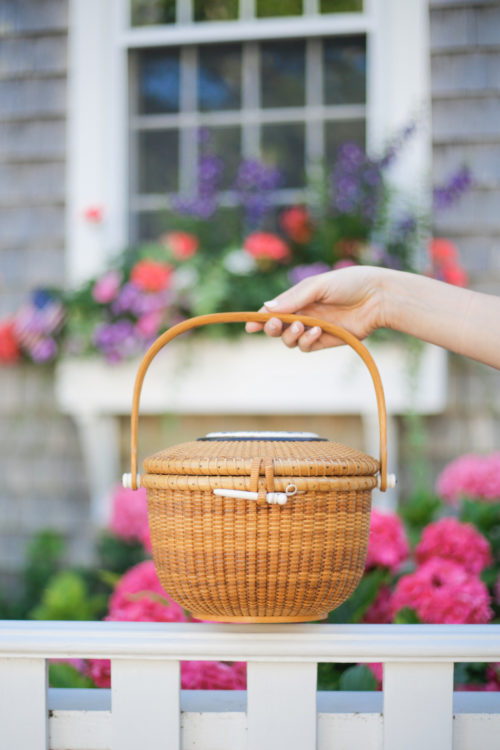
{The Nantucket lightship basket my mom passed down to me!}
Authentic lightship baskets are woven with rattan or cane, have a solid wooden base, and are woven on a wooden mold. The wooden base provides strength and structure for the rest of the basket, which explains the durability and heirloom quality of these baskets as they are passed from one generation to the next.
While many Nantucket lightship baskets are carried as handbags today, the original baskets were more utilitarian in nature and usually intended to nest within one another, often in groupings of two or four. Many of the early baskets had one or two handles and were left open at the top.
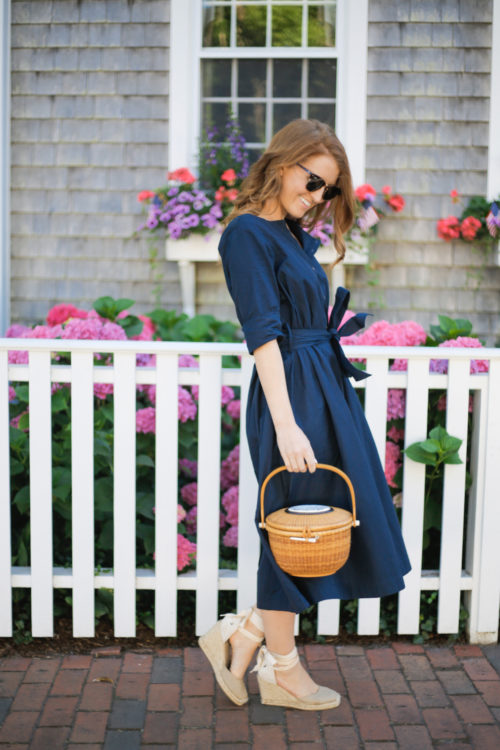
{Carrying my Nantucket lightship basket for the first time}
The history of Nantucket lightship baskets dates back more than 150 years. They were initially woven on whaling vessels from the 1830s to 1850s, where woodworkers called coopers made barrels to hold whale oil after the whales had been speared. These coopers had all the ingredients for making these baskets on board: woodworking tools, raw materials, and long expanses of time waiting for whales to be caught and drained of their valuable fuel.
With a rise in the whaling industry off the coast of Nantucket, the state of Massachusetts commissioned “lightships” (think floating lighthouses) beginning in 1856 to provide light for passing ships in heavily trafficked waters and dangerous shoals leading up to the island in the hopes of preventing shipwrecks. The crewmen aboard these lightships had lots of idle time and wove “lightship baskets” during the day since the need to guide ships was primarily after dark.
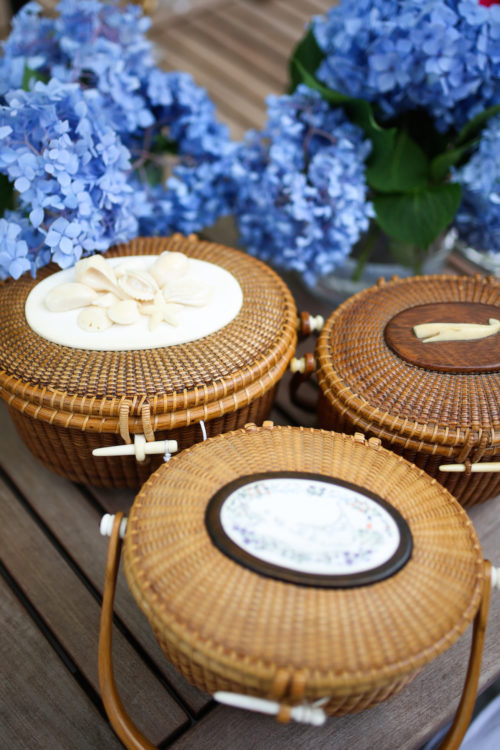
{My Grandy, Aunt Jill, and mom’s Nantucket lightship baskets at my bridal shower}
According to many historians, some of the best lightship baskets were constructed between 1870 and 1890. The government actually prevented the crewmen’s ability to weave baskets aboard the lightships in the early twentieth century, considering this work moonlighting. The making of these baskets consequently moved from sea to land, but retained the name lightship baskets.
Over the ensuing 40 years, molds, tools, and tricks of the trade were shared among artists who made a living weaving these baskets. Beginning around 1900, prominent local weavers would sign their baskets, adding to their value over time.

{A Nantucket lightship basket art print in our Nantucket powder room}
In 1948, a weaver named Jose Formoso Reyes came to Nantucket. He was a skilled craftsman who graduated from Harvard after growing up in the Phillipines. He contributed to a significant evolution in these baskets, adding a lid so women could use them as handbags. Charlie Sayle, a local fisherman, master carpenter, and ivory carver, carved a small ivory whale which was glued to the top of one of Reyes’s basket lids, creating the friendship lightship basket style so sought after today.
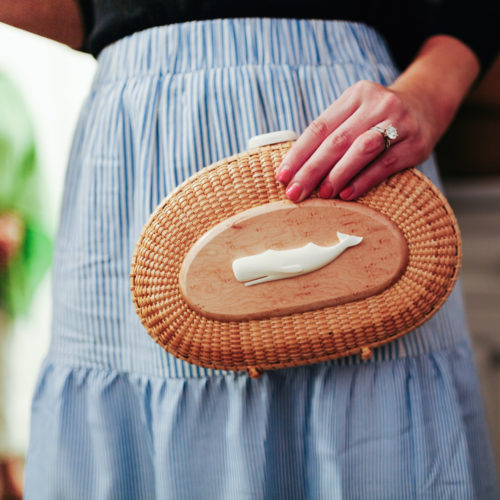
{A Nantucket lightship basket clutch I fell in love with at Grandy’s surprise party, a week before my bridal shower!}
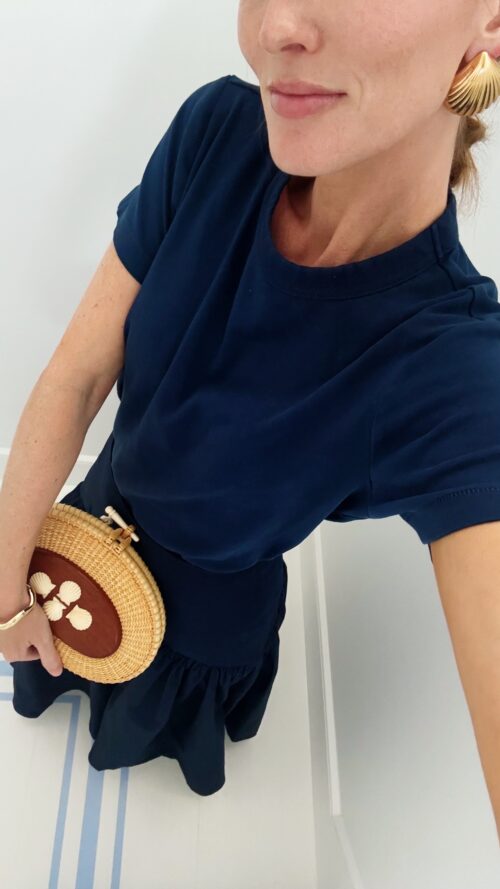
{And the lightship basket clutch we had made at Four Winds Craft Guild eight years later, after the birth of our fourth baby boy!}
My Grandy received her first Nantucket lightship basket in 1954 as a gift from my grandfather. It was woven by Stephen Gibbs, with a small whale ivory carving made by Nancy Chase. She passed this basket onto my Aunt Jill upon her college graduation in 1976.
In 1966, Grandy and her husband went to Stephen Gibbs’s studio to pick up her lightship basket after a minor repair. Knowing from my grandfather that Grandy coveted a larger basket, Mrs. Gibbs suggested she try one that she had nearby. Grandy admired the beautiful basket, topped with an ivory seagull, in the mirror. Mrs. Gibbs suggested that Grandy open the lid, where to her great surprise she discovered an ivory quarterboard featuring her name and the year, prearranged by my grandfather. She was so surprised and overjoyed that she hugged not only my grandfather but Mr. and Mrs. Gibbs as well.

{Carrying my mom’s lightship basket at our rehearsal dinner in 2017}
My mother’s lightship basket was made for her as a college graduation gift in 1980. The basket was woven by Jeanne Reis (grandmother of Michael Kane, who still makes lightship baskets today) and the ivory carving on the top was engraved by Nancy Chase. The top includes many of my mother’s favorite things on Nantucket: Sankaty Lighthouse (where we took our engagement pictures!), the old windmill, and several of the island’s indigenous flowers. Despite appreciating the thoughtfulness of the gift, my mom has never carried a purse as long as I’ve known her, and graciously passed it down to me as an early wedding present. I could not have been more surprised and have adored carrying her basket on island every summer since… and for many more to come!

P.S. If you’re interested in learning more about the history of Nantucket lightship baskets, I strongly encourage a visit to the Nantucket Lightship Basket Museum’s collection now housed at the Hadwen House (96 Main Street) next time you’re on island! I loved learning more about the history of these pieces — it makes me appreciate mine that much more!
P.P.S. If you enjoyed this post, you might also enjoy this one about what Nantucket means to me!